Скала NIHSS за Оценка на Тежестта на Инсулта
NIHSS предоставя стандартизирана класификация на тежестта на инсулта въз основа на обективна неврологична оценка. Общият скор варира от 0 до 42. Интерпретацията на резултата ориентира клинициста при избора на терапевтична стратегия и оценката на прогнозата за функционално възстановяване.
Изчисли NIHSS скор →
National Institute of Health Stroke Scale
1. a) Level of Consciousness
The investigator must choose a response if a full evaluation is prevented by such obstacles as an endotracheal tube, language barrier, orotracheal trauma/bandages. A 3 is scored only if the patient makes no movement (other than reflexive posturing) in response to noxious stimulation.
1. b) Ask for the current month and his/her age
The answer must be correct - there is no partial credit for being close. It is important that only the initial answer be graded and that the examiner not "help" the patient with verbal or non-verbal cues.
1. c) Ask to blink eyes and squeeze hands
Substitute another one step command if the hands cannot be used. Credit is given if an unequivocal attempt is made but not completed due to weakness. If the patient does not respond to command, the task should be demonstrated to him or her (pantomime), and the result scored (i.e., follow s none, one or two commands). Patients with trauma, amputation, or other physical impediments should be given suitable one-step commands. Only the first attempt is scored.
2. Test horizontal extraocular movements
If a patient has an isolated peripheral nerve paresis(CN III, IV or VI), score a 1. Gaze is testable in all aphasic patients. Patients with ocular trauma, bandages, pre-existing blindness, or other disorder of visual acuity or fields should be tested with reflexive movements, and a choice made by the investigator. Establishing eye contact and then moving about the patient from side to side will occasionally clarify the presence of a partial gaze palsy.
3. Test visual fields
Visual fields (upper and lower quadrants) are tested by confrontation, using finger counting or visual threat, as appropriate. Patients may be encouraged, but if they look at the side of the moving fingers appropriately, this can be scored as normal. If there is unilateral blindness or enucleation, visual fields in the remaining eye are scored. Score 1 only if a clear-cut asymmetry, including quadrantanopia, is found.
4. Test facial palsy
Ask – or use pantomime to encourage – the patient to show teeth or raise eyebrows and close eyes. Score symmetry of grimace in response to noxious stimuli in the poorly responsive or non-comprehending patient. If facial trauma/bandages, orotracheal tube, tape or other physical barriers obscure the face, these should be removed to the extent possible.
5. a) Test left arm motor drift
The limb is placed in the appropriate position: extend the arms (palms down) 90 degrees (if sitting) or 45 degrees (if supine). Drift is scored if the arm falls before 10 seconds. The aphasic patient is encouraged using urgency in the voice and pantomime, but not noxious stimulation. Each limb is tested in turn, beginning with the non-paretic arm. Only in the case of amputation or joint fusion at the shoulder, the examiner should record the score as untestable (UN).
5. b) Test right arm motor drift
The limb is placed in the appropriate position: extend the arms (palms down) 90 degrees (if sitting) or 45 degrees (if supine). Drift is scored if the arm falls before 10 seconds. The aphasic patient is encouraged using urgency in the voice and pantomime, but not noxious stimulation. Each limb is tested in turn, beginning with the non-paretic arm. Only in the case of amputation or joint fusion at the shoulder, the examiner should record the score as untestable (UN).
6. a) Test left leg motor drift
The limb is placed in the appropriate position: hold the leg at 30 degrees (always tested supine). Drift is scored if the leg falls before 5 seconds. The aphasic patient is encouraged using urgency in the voice and pantomime, but not noxious stimulation. Each limb is tested in turn, beginning with the non-paretic leg. Only in the case of amputation or joint fusion at the hip, the examiner should record the score as untestable (UN), and clearly write the explanation for this choice.
6. b) Test right leg motor drift
The limb is placed in the appropriate position: hold the leg at 30 degrees (always tested supine). Drift is scored if the leg falls before 5 seconds. The aphasic patient is encouraged using urgency in the voice and pantomime, but not noxious stimulation. Each limb is tested in turn, beginning with the non-paretic leg. Only in the case of amputation or joint fusion at the hip, the examiner should record the score as untestable (UN), and clearly write the explanation for this choice.
7. Test limb ataxia
This item is aimed at finding evidence of a unilateral cerebellar lesion. Test with eyes open. In case of visual defect, ensure testing is done in intact visual field. The finger-nose-finger and heel-shin tests are performed on both sides, and ataxia is scored only if present out of proportion to weakness. In case of blindness, test by having the patient touch nose from extended arm position.
8. Test sensation
Sensation or grimace to pinprick when tested, or withdrawal from noxious stimulus in the obtunded or aphasic patient. Only sensory loss attributed to stroke is scored as abnormal and the examiner should test as many body areas (arms [not hands], legs, trunk, face) as needed to accurately check for hemisensory loss.
9. Test language
If visual loss interferes with the tests, ask the patient to identify objects placed in the hand, repeat, and produce speech. The intubated patient should be asked to write. The examiner must choose a score for the patient with stupor or limited cooperation, but global aphasia answer should be used only if the patient is mute and follows no one-step commands.
10. Test dysarthria
If patient is thought to be normal, an adequate sample of speech must be obtained by asking patient to read or repeat words. If the patient has severe aphasia, the clarity of articulation of spontaneous speech can be rated. Only if the patient is intubated or has other physical barriers to producing speech, the examiner should record the score as untestable. Do not tell the patient why he or she is being tested.
11. Test extinction and inattention
Sufficient information to identify neglect may be obtained during the prior testing. If the patient has a severe visual loss preventing visual double simultaneous stimulation, and the cutaneous stimuli are normal, the score is normal. If the patient has aphasia but does appear to attend to both sides, the score is normal. The presence of visual spatial neglect or anosagnosia may also be taken as evidence of abnormality. Since the abnormality is scored only if present, the item is never untestable.
Класификация по тежест
| NIHSS скор | Тежест на инсулта |
|---|
| 0 | Без симптоми на инсулт |
| 1–4 | Лек инсулт |
| 5–15 | Умерен инсулт |
| 16–20 | Умерено тежък инсулт |
| 21–42 | Тежък инсулт |
По-високият скор е свързан с по-лоши функционални резултати и по-висок риск от смъртност. Серийната оценка позволява проследяване на динамиката на неврологичния статус.
Кога да използвате инструмента
- За стратификация на пациенти с остър инсулт при постъпване
- При планиране на интензитета на рехабилитационната програма
- При вземане на решение за ниво на грижа (инсултово отделение, ИКО)
- За сравнение на изходния и текущия неврологичен статус
Ограничения
Еднократният NIHSS скор не е достатъчен за прогноза за индивидуалния пациент. Инсулти в задната ямка може да се манифестират с нисък NIHSS скор въпреки значителна клинична тежест. Инструментът е за образователни цели.
Често задавани въпроси
Пациент с NIHSS 3 счита ли се за кандидат за тромболиза?
Решението за тромболиза зависи от множество фактори: давност на симптомите, неврообразна картина и съпътстващи заболявания. Ниският NIHSS скор не изключва автоматично кандидатурата. Насоките на AHA/ASA препоръчват индивидуална оценка.
Промяна с колко точки по NIHSS се счита за клинично значима?
Промяна от 4 или повече точки се счита за клинично значима в клиничните проучвания. В клиничната практика всяка промяна в скора изисква преоценка.
Влияе ли афазията непропорционално на крайния скор?
Тежката афазия може да повлияе на оценката на множество елементи. При пациенти с изолирана афазия клиничната тежест може да бъде подценена от общия скор.
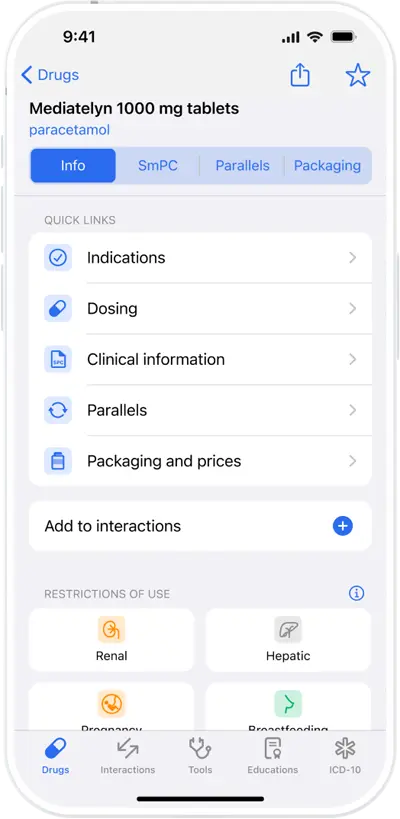
Инструментът е достъпен в приложението Mediately
Оцени тежестта на инсулта →
Източници
- Brott T, et al. Measurements of acute cerebral infarction: a clinical examination scale. Stroke. 1989;20(7):864–870.
- Powers WJ, et al. Guidelines for the Early Management of Patients With Acute Ischemic Stroke: 2019 Update to the 2018 Guidelines. Stroke. 2019;50(12):e344–e418.
- Adams HP Jr, et al. Baseline NIH Stroke Scale score strongly predicts outcome after stroke: a report of the Trial of Org 10172 in Acute Stroke Treatment (TOAST). Neurology. 1999;53(1):126–131.